A remote change workshop? Is that even possible?
Yes, it is! After publishing our articles about remote workshops, we received some questions about which specific workshops are possible online. This article is a guide on how to practically run a remote change management workshop in eight steps.
We describe our approach in detail that you not only can understand it step by step, but also apply the proposed methods yourself more easily. Are we nuts to share our intellectual property? We don’t think so. We’d like to support our clients and colleagues in difficult times like these. We believe in growing by sharing, to learn and benefit from each other.
Before we dive into the eight steps, an exceptional thanks goes to our pioneering clients that have been courageous enough to enter unknown territory. Necessity is the mother of invention. It has been the mother of this remote change management workshop, too.
The article is based on a remote workshop for a newly formed leadership team, consisting of a head of division and his seven direct reports. The division just recently underwent a major reorganisation. Purpose of this remote change management workshop was:
1. Strengthen trust within the newly built leadership team
2. Provide room to express concerns
3. Increase optimism and confidence in the future
4. Develop a mission statement for the division
5. Jointly create a roadmap of change management measures
For the sake of data privacy, we changed names and anonymised all data.
Step #1: what do you have in your change backpack?
Objective: (Re)activate the individual change management resources.
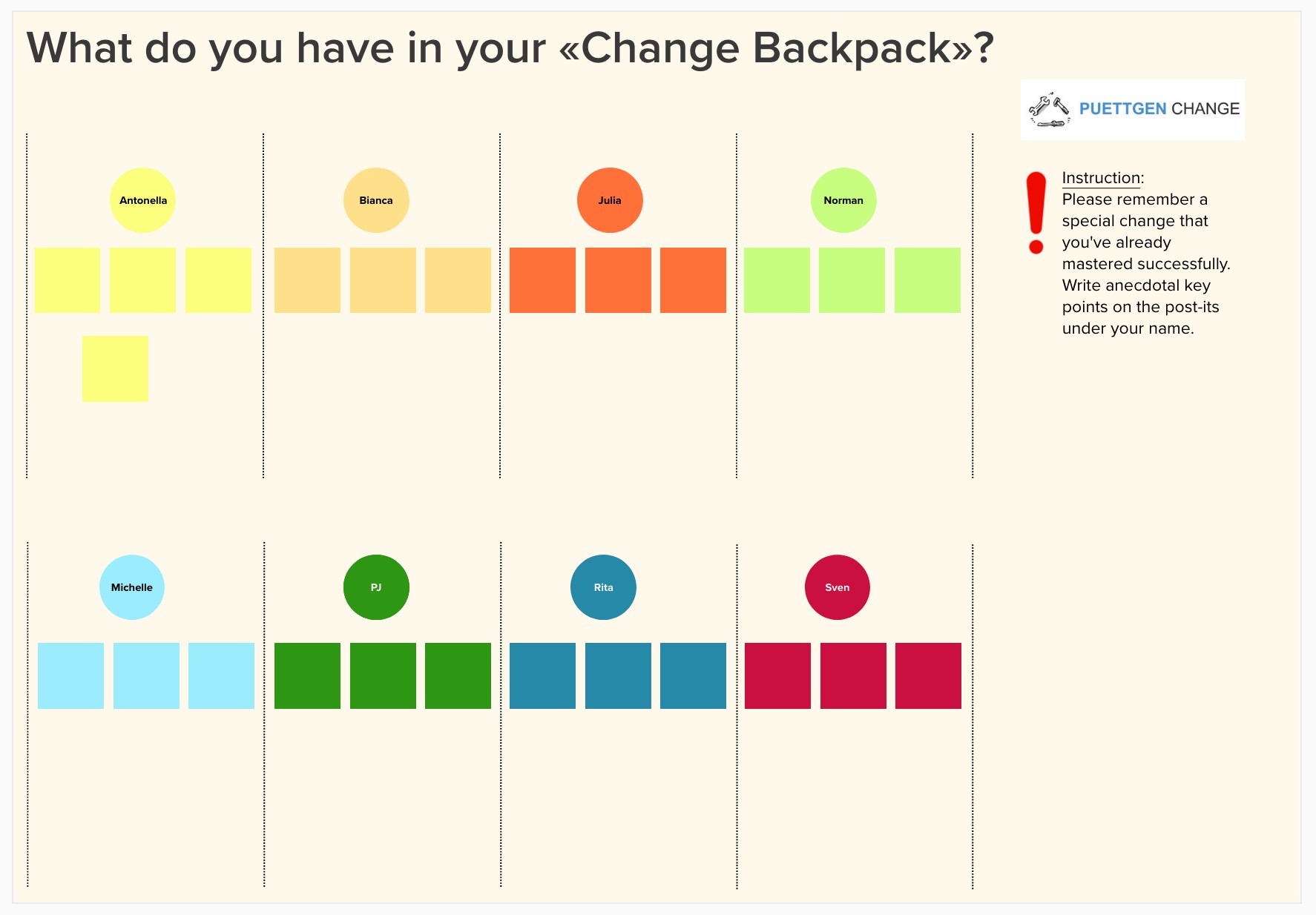
As a check-in to our remote change management workshop, we ask our participants to get reconnected with their already existing change management competencies and resources. Why is that? We believe that all human beings are change experts by birth. It’s only that some of us have either forgotten about this already existing knowledge or have just a lack of confidence due to a particularly challenging transformation they face. So we start with asking our participants to reflect on significant life change events or earlier business transformations they already have mastered. It can be done either as the preparation task, in which everyone individually reflects about the question in advance. As a subtle side effect, everyone would need to make oneself familiar with Mural, the essential collaboration tool we use. Alternatively, it could be the first warming-up exercise, in which for example teams of two would interview each other and log their findings on a Mural canvas. The effect of this exercise is that a team realises how much change management expertise and resilience it already has at its disposal. Also, people get to know each other better, which leads to a positive bond within the team.
Step #2: How would I describe our current transformation symbolically?
Objective: Create a space to discuss personal thoughts and possible concerns.
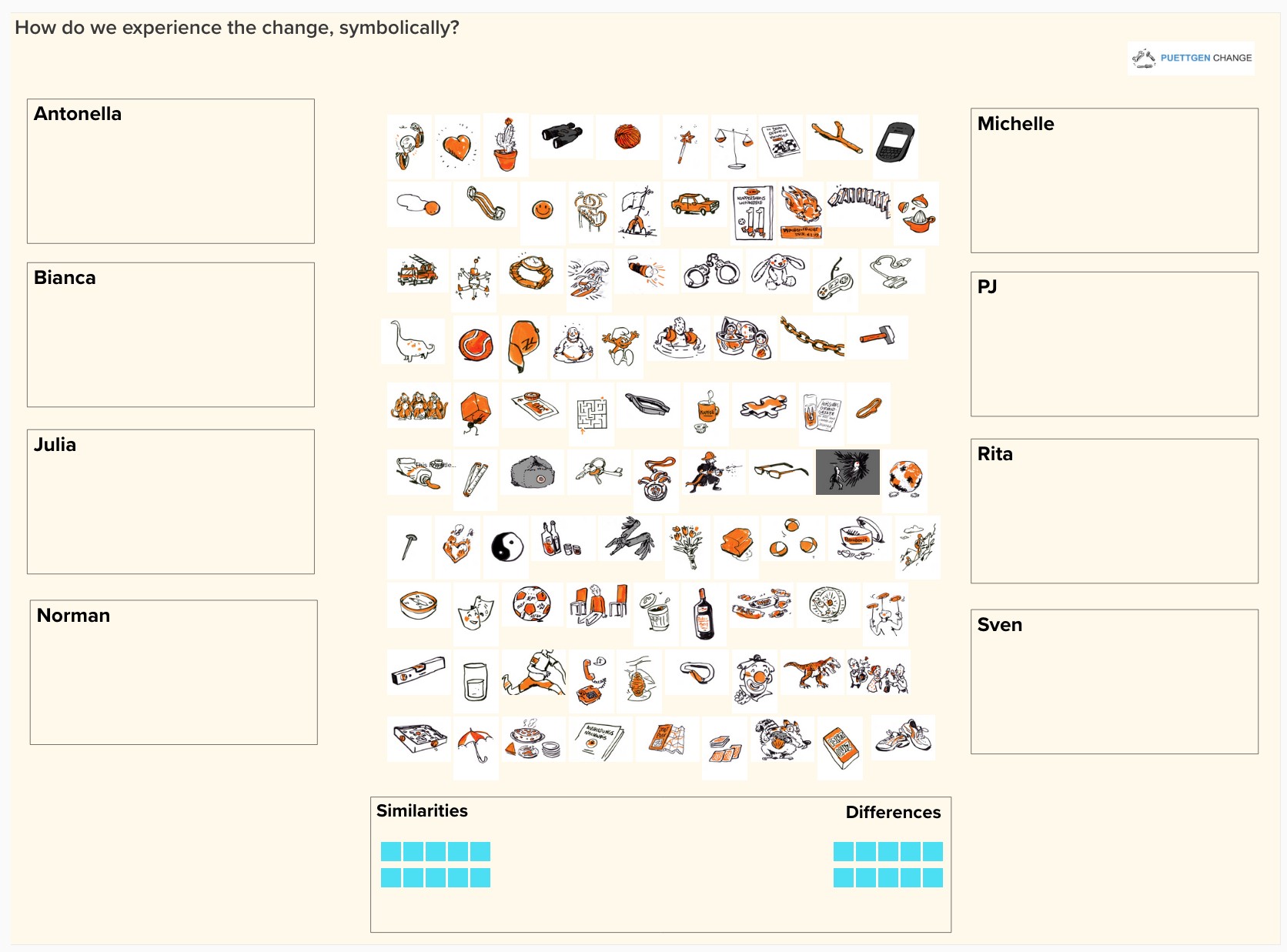
In the context of a more than 50 change workshops, we’ve asked our participants to bring an object expressing how they perceive the ongoing transformation. We’ve selected the most common symbols and Till Lassmann turned them into picture postcards, which we usually distribute on the floor in a seminar room. Luckily, the remote version of this exercise is as effective and successful as its traditional on-site equivalent. We’ve put Till’s drawings on a Mural canvas and simply instruct our participants: “Please choose one or more symbols that represent how you perceive the current situation. Drag and drop them to the designated area of the canvas under your name.” After everyone has made a choice, one after the other shares the story associated with the symbols. We love this exercise very much, since people reveal a tremendous amount of relevant information when they talk about the symbols they’ve picked. In a minimum of time, they start talking about the elephant in the room, addressing their thoughts and concerns. At the end of this exercise, we reflect about common themes and striking patterns, similarities or differences. People start realising, that their colleagues make the same observations and that all of them are being in the same boat. This exercise creates a strong feeling of common understanding and shared sense of urgency.
Step #3: The famous Kübler-Ross curve - where am I? Where is my team located?
Objective: Provide an overview of the overall situation in the division.
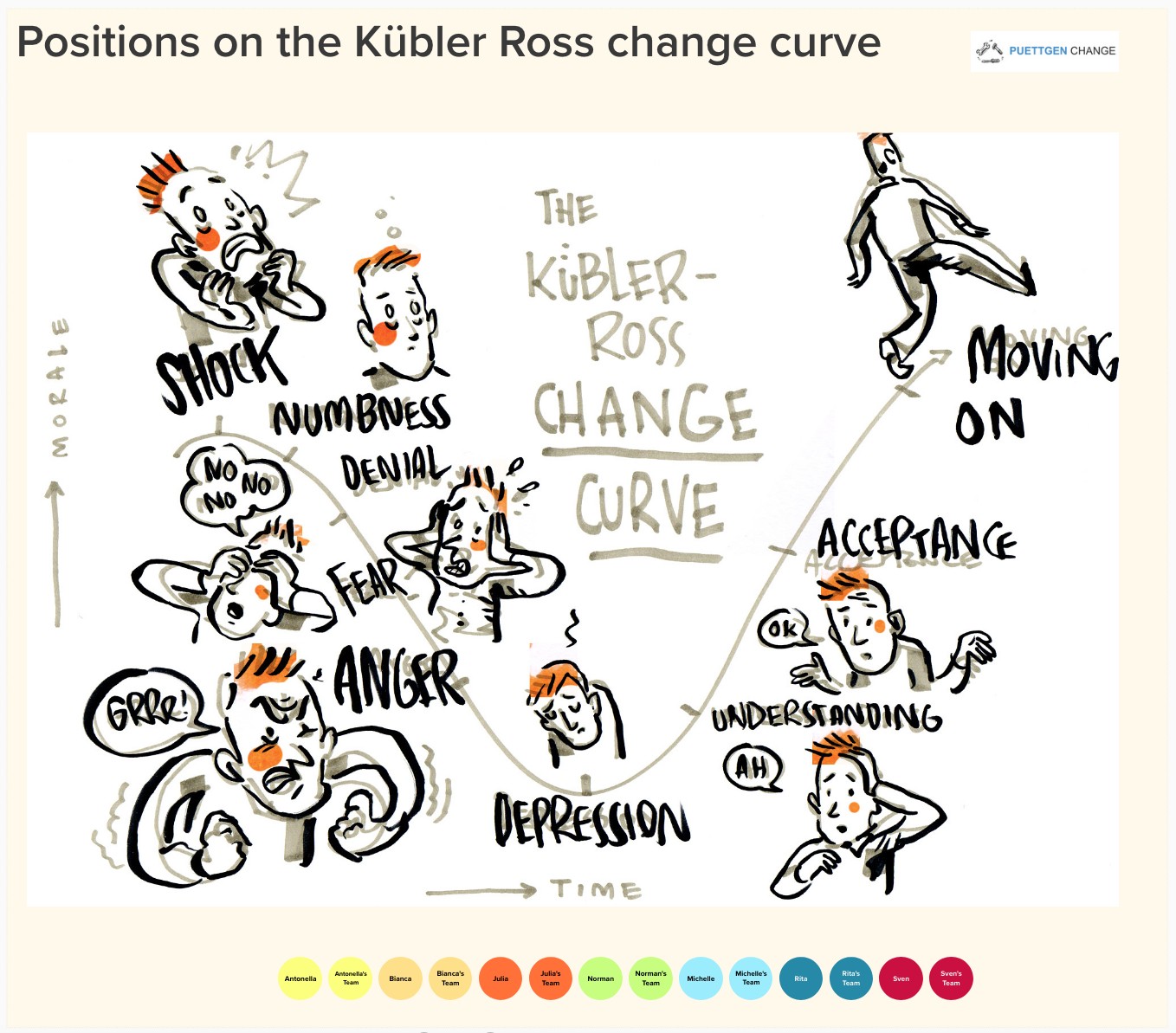
The Kübler-Ross curve belongs to the classics among change management tools. The unique charm of it: participants can compare their positions and the position of the teams they lead, relative to all members of the leadership team. It enables a precise snapshot of the overall picture in the division. Again, we use a great drawing, made by Till Lassmann, which depicts the change curve and the corresponding emotions per stage. Placed in the middle of a Mural canvas, we invite our participants to put virtual sticky notes on the curve, one for their position, another for the location of the team they lead.
Step #4: A pyramid dialogue to develop the Why statement.
Objective: Develop a mission statement for the division.
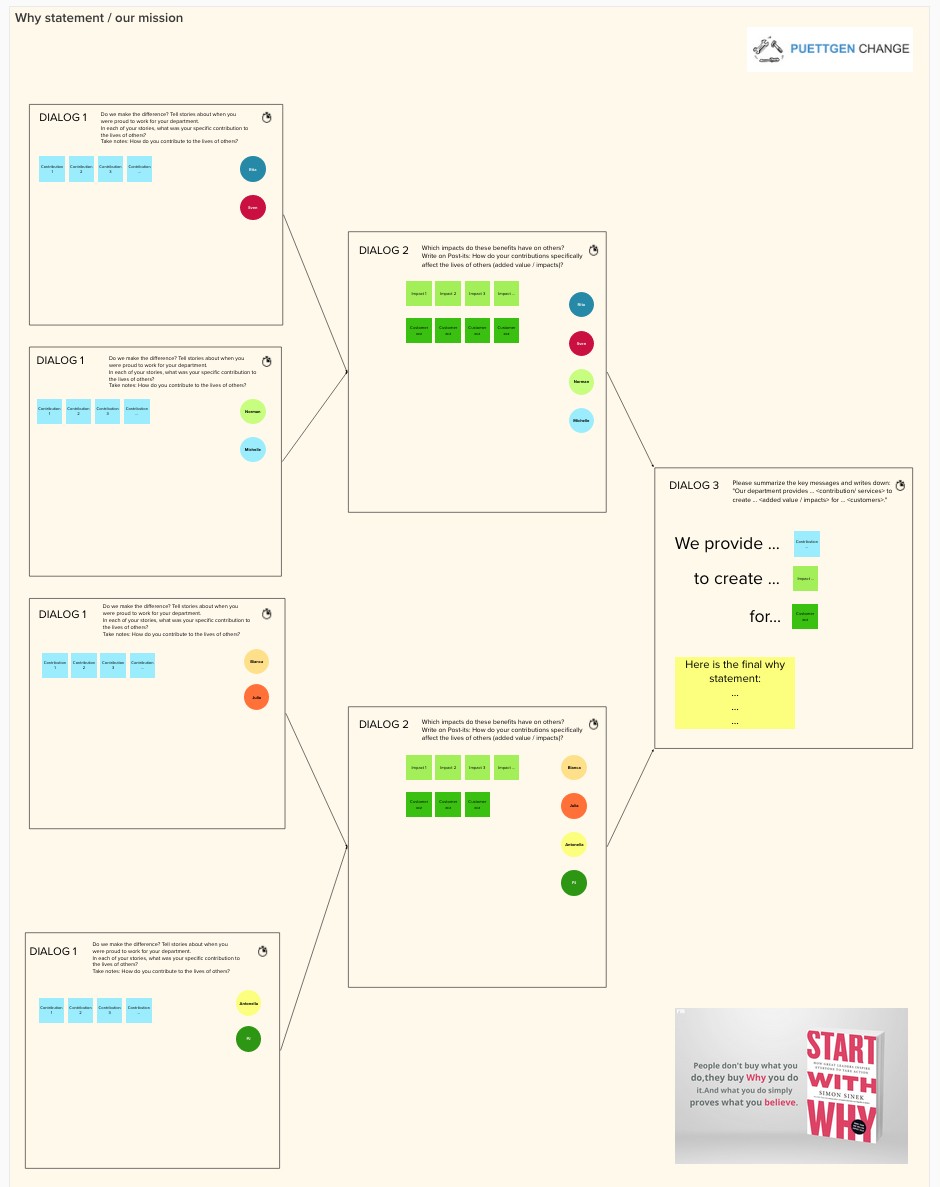
In preparation for this event, we had an individual preliminary talk with each participant. These interviews aimed to promote a trusting relationship between participants and facilitator. At the same time, it helped to diagnose the initial situation of the leadership team. It turned out that there was no overarching goal which connected the individual departments and made them dependent on each other. In our experience, this happens to be the case very often. Organisations talk teams, but do not lead and incentivise accordingly. Strictly speaking, our client’s team may have been a good group in which their members may even find each other likeable. But it was not a team. We know for a fact, that team building without a joint mission, that everyone identifies with, remains nothing more than a pious wish. Therefore, our change management workshop starts with the development of a mission statement. We initially thought that this would be a significant challenge for the remote workshop. However, a pyramid dialogue turned out to be the right solution. Small groups start and iteratively merge to larger groups until all results finally flow together in one shared understanding, the top of the pyramid. All results are directly recorded in Mural using virtual sticky notes. One person per dialogue has the task of inviting the others to a video call and also to keep an eye on the timing. Based on Simon Sinek’s Start with Why approach, we offer three rounds of dialogues:
Dialogue 1: What are we good at, and how do we contribute to the lives of others?
Dialogue 2: What impact do these contributions have on our customers?
Ultimately, in Dialog 3, all the individual factors were combined into why statements.
With Mural’s voting function, the leadership team chooses the into why statements everyone could identify with.
Step # 5: Back to the future: our division in one year from now.
Objective: Put the participants in the desired target state and come up with solution-oriented measures how to act in the future.
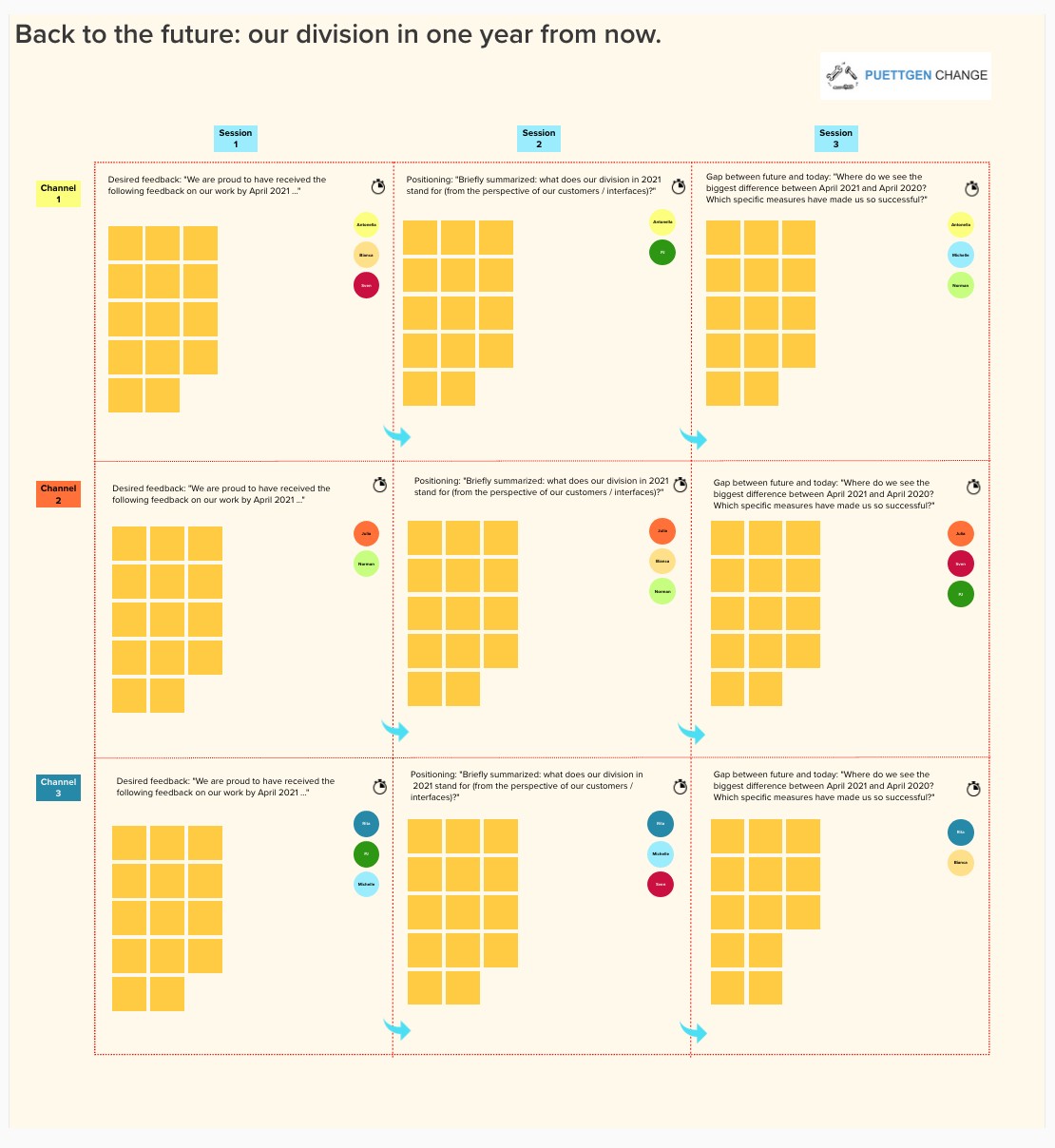
The well-known World Café method offers an excellent opportunity to have interactive dialogues. Traditionally, like in a real café, there are several tables. Each table has a host who welcomes new guests and briefly explains what has been discussed through previous rounds of the discussion. To log the findings, all guests are encouraged to write on the tablecloth. The guests change every round and find themselves at a new table in another mix. Only the hosts stay at their table. An exceptional quality of world cafés is its simultaneous and focused processing of a topic. Through the interactive approach, central ideas crystallise and even large groups can get involved in a participatory and co-creative manner. Fortunately, the World Café method can be virtualised to be applied in a remote workshop setting, too.
Corresponding with the traditional tables, we define “channels” in Mural, which each have a host. We have assigned the hosts and their guests at random for each new round. In practice, that means, the host invites the guests to a video call. People log the results of their conversations by virtual sticky notes they place on the Mural canvas. In round 1, all channels put themselves into the future. More specifically, one year from today: “What positive feedback are we proud to receive in a year?” In round 2, the guests take the future perspective of the division’s customers: “What does the division stand for from our customers’ point of view in one year?” Finally, in round 3, all groups analyse the gap between the desired future state and today’s situation: “Where do we see the biggest difference? Which specific measures will have made us so successful?”
Step # 6: key dimensions for action.
Objective: Cluster the measures found and derive the key dimensions for action.
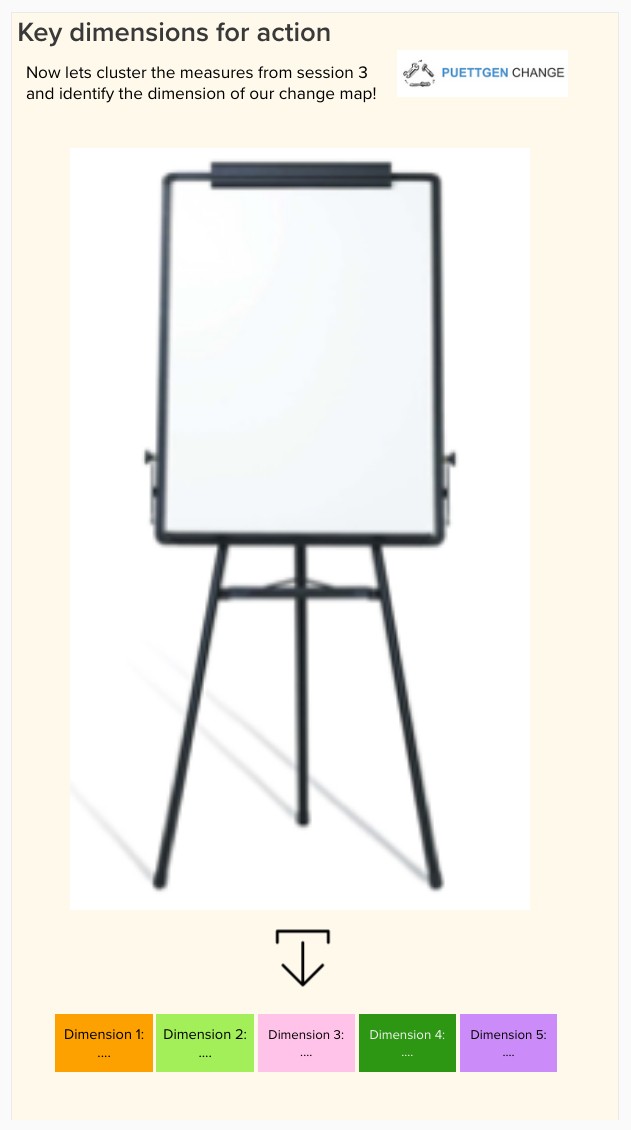
Mural helps to sift through and sort out all the measures from the World café. First, we copy all of the suggested actions onto a new Mural canvas. Then we apply the “Silent Clustering” method. That means we allow everyone to sort the sticky notes by topic without speaking. We recommend having no more than 6 clusters, to keep a good overview. After a few minutes, a natural balance establishes itself, and the main clusters have developed. Finally, we choose concise and keyword-like titles for the clusters. These serve as the dimensions of our change map from step 7.
Step # 7: Develop the change map.
Objective: Jointly design a roadmap for working together.
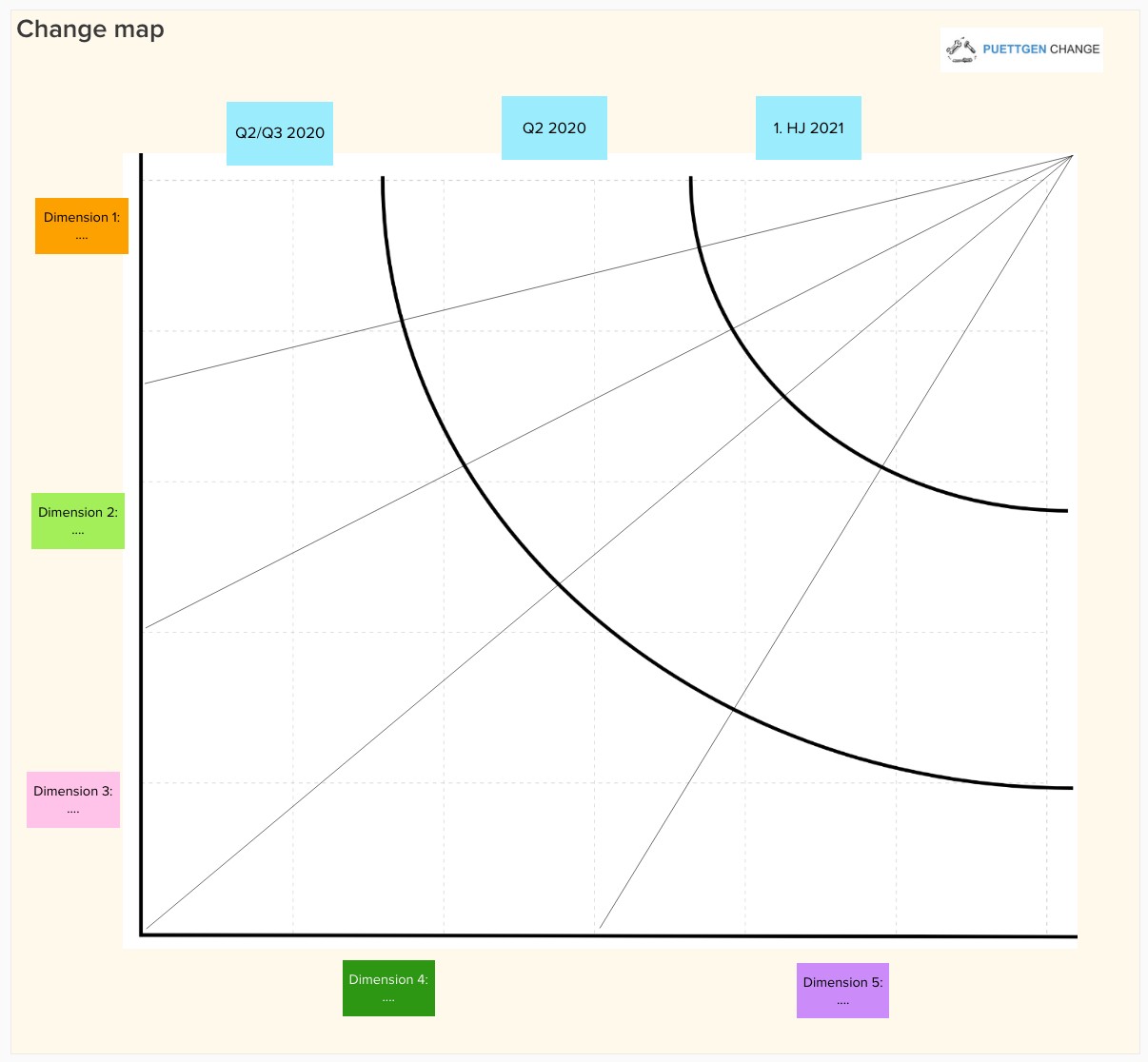
We form two subgroups at random to work out the “dimensions of action”, identified in step 6. As before, one person has the task of inviting all other subgroup members to a video call. One subgroup focuses on the odd dimensions, the second one on the even dimensions. In both subgroups, each suggested measure from the world café has to be operationalised and plotted on a timeline. Per action, a sticky note logs the “Title”, its “Objective”, its “Key stakeholders” and the “Estimated Effort”.
Step # 8: Define the backlog / next steps.
Objective: Jointly design a roadmap for working together.
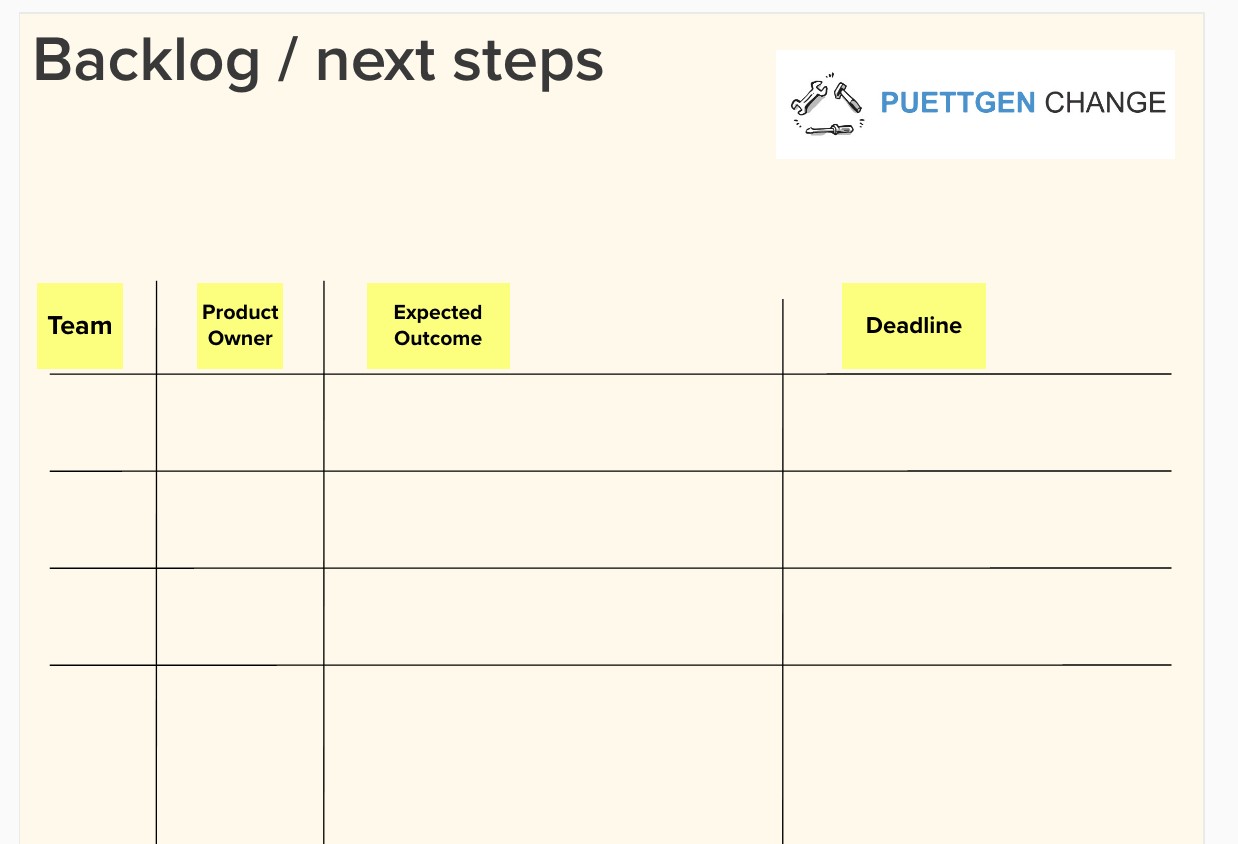
To get things rolling, the final step of our remote workshop is dedicated to the transfer into practice. The leadership team jointly determines which tasks qualify for the first working period (or sprint). A table summarises who will work for which product owner on what precisely and, if necessary, until which deadline.
Some remarks
From our practical experience, it is possible to partition the entire workshop on two mornings. We recommend mornings, since we have learned that concentration for a remote seminar is usually better at the beginning of one’s workday. It is also conceivable to divide the workshop into even smaller units. As logical units, it makes sense to bundle steps 1 to 3 and steps 5 to 7. Step 4 would work separately. In any case, step 8 should complete the individual units to close each subpart with a transfer planning.
Mural has proven to be an excellent tool with a fast customer service. In any case, you should check for applicability in the desired company. Problems with Internet Explorer are not uncommon. The Google Chrome browser also causes occasional hick-ups if the user works with browser extensions. Safari and Firefox work perfectly fine.
Another big thank you goes to our marvellous colleague Till Lassmann, who supports us in developing appealing and meaningful drawings. Thanks to Till, we see: a picture says more than a thousand words.
Feedback is highly welcome!